


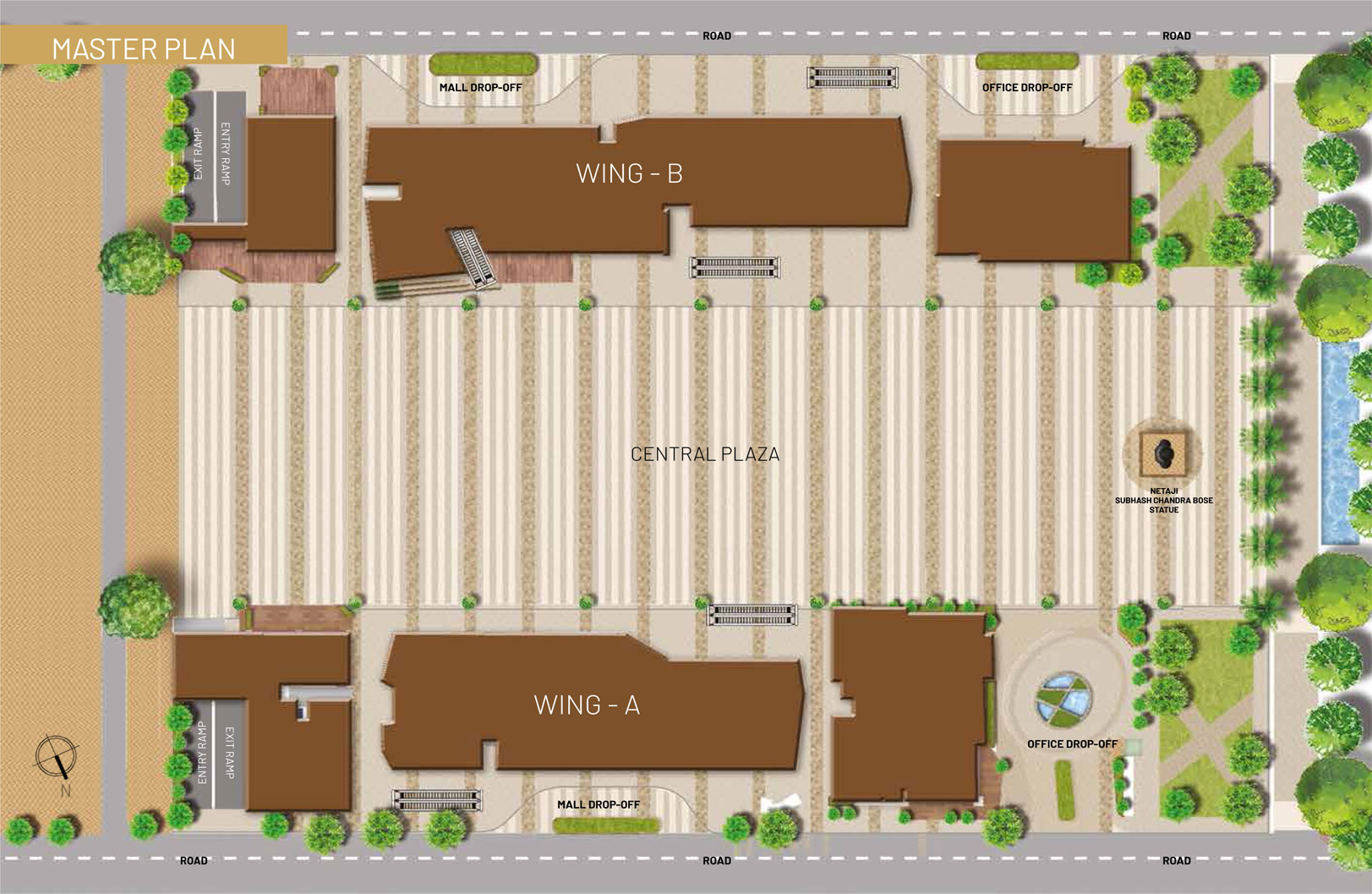
The master plan of County Courtyard moves beyond a conventional mixed-use layout, bringing together retail, workspaces, dining, and leisure into a single, well-connected ecosystem where every level serves a clear purpose. The intent is not just vertical stacking of functions, but thoughtful zoning that enables smooth transitions between commerce, work, and social engagement. Spread across approximately 1.1 lakh sq. ft. of development footprint, the project integrates 1,10,347 sq. ft. of retail space and 2,82,875 sq. ft. of office space, supported by 13,000 sq. m. of dedicated leisure area. Each component fits into a larger spatial logic, ensuring that movement, visibility, and usability remain uninterrupted across the site.
The master plan is anchored in a layered zoning approach, where each function operates independently while staying connected within the larger framework.
This zoning ensures that each user group, visitors, professionals, and tenants, experiences the development without friction.
At the core of the master plan lies its defining architectural move: Twin towers (Wing A and Wing B) connected through a Central Cultural Plaza.
This configuration allows:
The Central Cultural Plaza acts as the heart of the project, bringing together movement, events, and shared experiences. Instead of isolating blocks, the master plan encourages interaction and visual continuity.
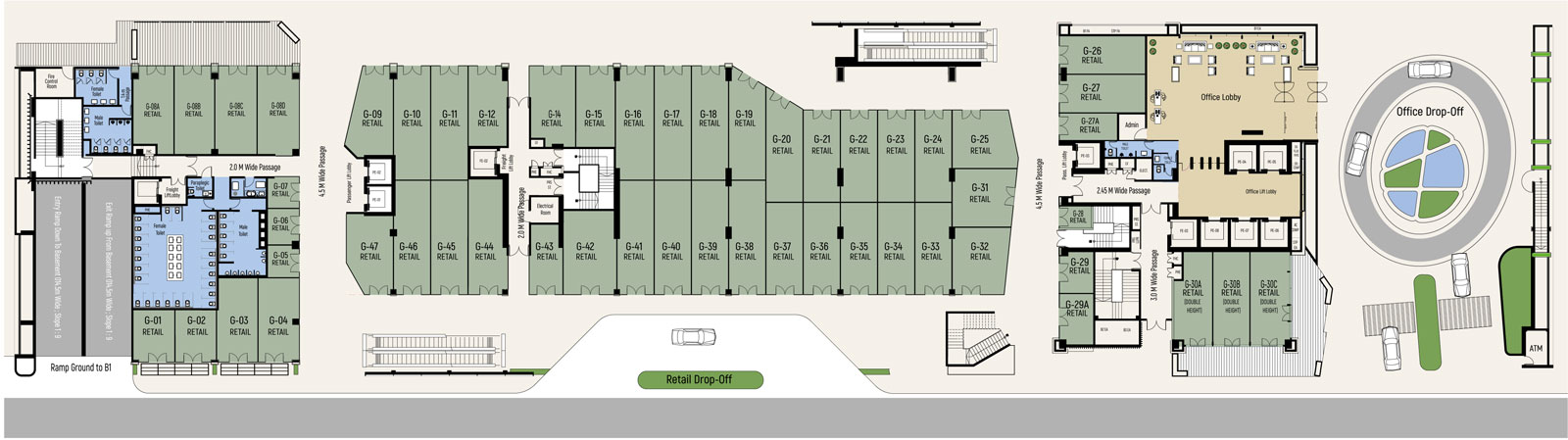
Retail is positioned as the primary activation layer of the development. The planning focuses on maximising visibility and accessibility:
This extended frontage:
The layout avoids fragmented retail pockets. Instead, it creates linear, high-visibility retail corridors that guide movement naturally across the development.
Wing A follows a streamlined vertical hierarchy designed for clarity and efficiency:
The planning ensures that retail energy remains concentrated at lower levels, while office spaces benefit from elevation, privacy, and reduced noise.
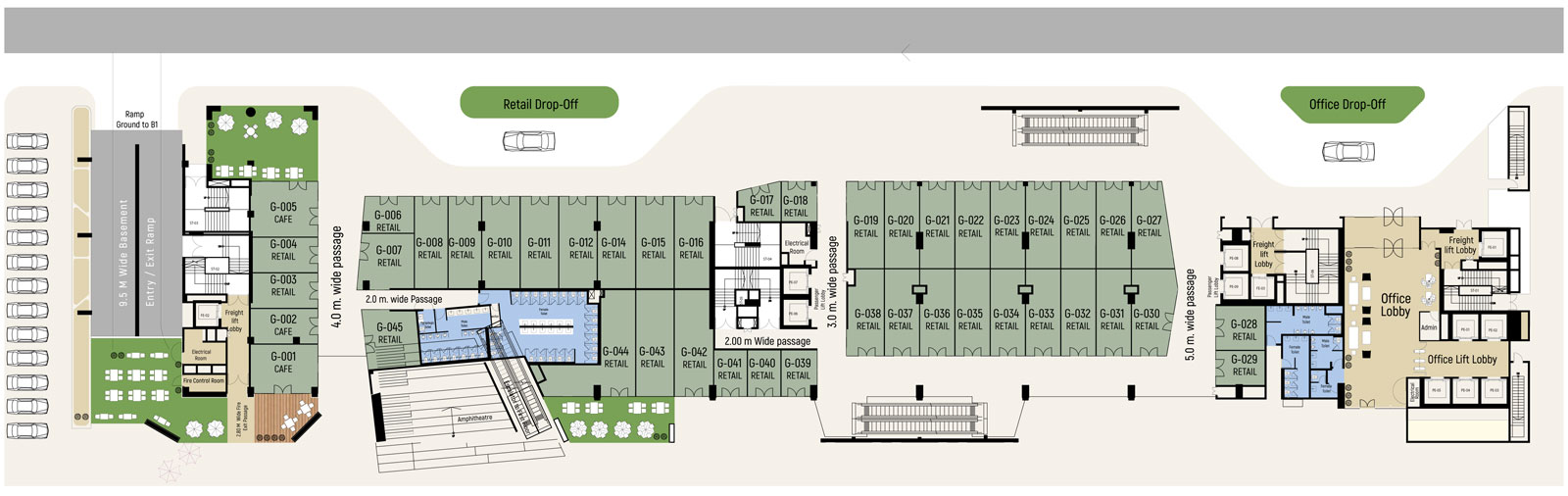
Wing B introduces a more layered experience, integrating entertainment into its vertical planning:
This structure allows Wing B to act as the experience-driven anchor, complementing Wing A’s more streamlined layout.
A key element of the master plan is the allocation of 13,000 sq. m. of leisure space, integrated across the development rather than confined to a single zone.
Key inclusions:
These spaces ensure that the development is not limited to transactional use, but supports engagement and extended stays.
The master plan prioritises clear and efficient circulation across all levels:
Movement within the development feels intuitive, reducing the need for complex navigation.
County Courtyard’s master plan is not just about allocation of space. It defines how people move, interact, and experience development across different times of the day. From strong retail frontages and structured office zones to integrated leisure spaces and a central cultural plaza, every element contributes to a cohesive and functional environment.
The result is a development where:
All within a single, well-orchestrated plan that prioritises both usability and experience.


Corporate Office
County Spaces
Plot No. 15, Sector-135
Noida-201305, U.P.
 info@countygroup.in
+91-120-4022100
info@countygroup.in
+91-120-4022100
Policies
Terms of Use
Privacy Policy
Disclaimer
Blog
Sitemap

Disclaimer: The imagery presented is for representative purposes only and may not accurately reflect the final product or exact details. Actual features, specifications, and designs may vary. Please refer to official documentation and materials for precise information. While every attempt has been made to ensure the accuracy of the plans shown, all measurements, positioning, fixtures, fittings and any other data shown are an approximate interpretation for illustrative purposes only and are not to scale. No responsibility is taken for any error, omission, misstatement or use of data shown. The company reserves the right to make changes in the plans, specifications, dimensions and elevations without any prior notice. 1 sq. ft. = 0.0929 sq. mt., 1 sq. mt. = 10.764 sq. ft, 1 ft. = 0.305 mt and 1 mt = 3.281 ft. Super Area: Super Area is (i) the entire area of the said flat enclosed by its periphery walls, including half of the area under common walls between two flats, and full area of walls in other case; area under columns, cupboards, window projections and balconies; and (ii) proportionate share of service areas to be utilized for common use and facilities, including but not limited to lobbies, staircase, circulating areas, lifts, shafts, passage, corridors, stilts, lift machine room, area for water supply arrangement, maintenance office, security/fire control rooms etc. Built up Area: Built up area, as per CREDAI definition, shall mean the total Polyline(P. Line) area measured on the outer line of the unit including balconies and /or terrace with or without roof. The outer walls which are shared with another unit shall be computed at 50% Remaining Outer walls are computed at 100%. Carpet Area: Carpet Area is the net usable floor area of an apartment, excluding the area covered by the external walls, areas under services shafts exclusive balcony or veranda area and exclusive open terrace area, but includes the area covered by the internal partition walls of the apartment.
© 2026 County Group. All Rights Reserved.